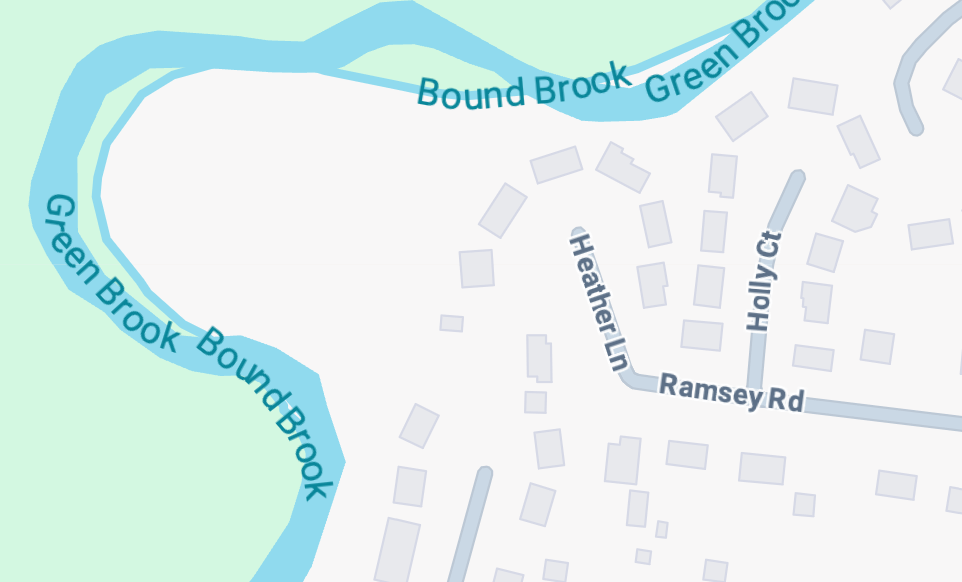
Subdivision plans for what was then-called the Rankin property proceeded before the Planning Board, with neighboring homeowners voicing various concerns.
Some were worried about congestion on nearby Ramsey Road. Others thought the number of homes should be whittled. The public hearing began in March 1986 and continued for several months.
During a March 26, 1986 meeting, two residents voiced concerns about the downstream area, noting erosion was already occurring. They questioned whether it would worsen if new homes were constructed on the Rankin parcel on what became Heather Lane. The questioners were assured the new project’s runoff protections were appropriate and would include a detention basin.
On June 25, 1986, the Middlesex Planning Board approved a plan for six homes on the 6.4-acre Rankin site proposed by Hearthstone Building Enterprises.
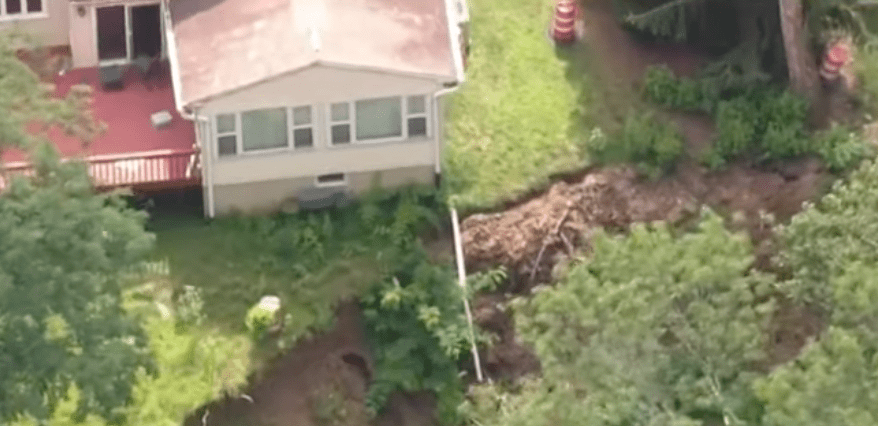
Today, serious erosion has caused one Heather Lane home to be vacated as uninhabitable, with the adjacent residence threatened. Borough officials fear that if unchecked, the problem could also affect nearby Holly Court homes.
There’s no evidence that runoff from the development is causing the current issue. Rather, it’s suspected that erosion worsened with the construction of a nearby flood wall as part of the Green Brook Flood Management Project and 2021’s Hurricane Ida.
Still, the two residents – who resided downstream on Beechwood Avenue – raised the question of erosion nearly four decades ago. They were assured by board members and Hearthstone’s engineer that Heather Lane stormwater could not be drained into the stream as per state Department of Environmental Protection (DEP) standards.
Mayor John Madden was asked by Inside – Middlesex on Dec. 8 if the municipality holds any liability for the imperiled Heather Lane homes given the Planning Board’s past approval.
“At this time, I cannot answer that question,” Madden replied.
Middlesex officials have been unsuccessful in getting the feds to intervene in the situation. The municipality is seeking a state grant in the hopes it would fund a long-term fix. In the short-term, the Borough Council has authorized using Belgian blocks to fortify the stream bank near the threatened homes.
The two downstream homeowners lived on Beechwood Avenue, according to 1986 meeting minutes. One was Mary Lou Viswat, who later served on the Borough Council in the 1990s and the Green Brook Flood Control Commission from the late 1990s until 2010. She passed away in 2012.
Viswat noted that the stream area’s “water line” was prone to flooding, referring to 1971. That was an apparent reference to Tropical Storm Doria, which deluged Middlesex in August of that year. She said her land “is getting a second brook” and is “constantly losing property.”
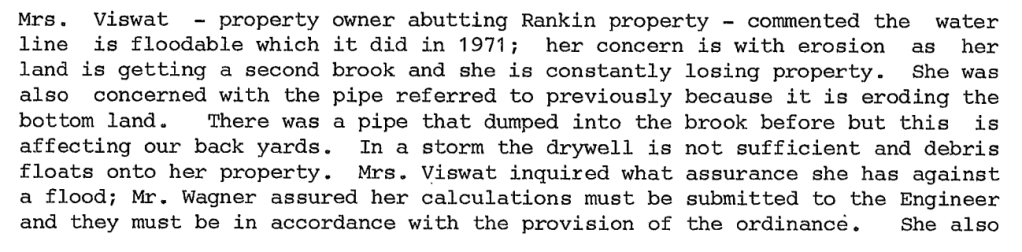
Minutes from a March 1986 Middlesex Planning Board hearing on what is now Heather Lane.
An existing drainage pipe that emptied into the stream was mentioned earlier in the hearing. Viswat claimed that pipe contributed to erosion and that debris would float onto her property.
Viswat also asked for assurance against future flooding. She received what reads as a head-scratching response, according to the minutes. A board member “assured her calculations must be submitted to the engineer and they must be in accordance with the provision of the ordinance.”
At one point, Hearthstone’s engineer brought other factors into the mix. He asserted that the two Beechwood Avenue homes in question were built in the 1960s, a time of more lax DEP stream regulations. In 1986, he claimed, they would not have been constructed.

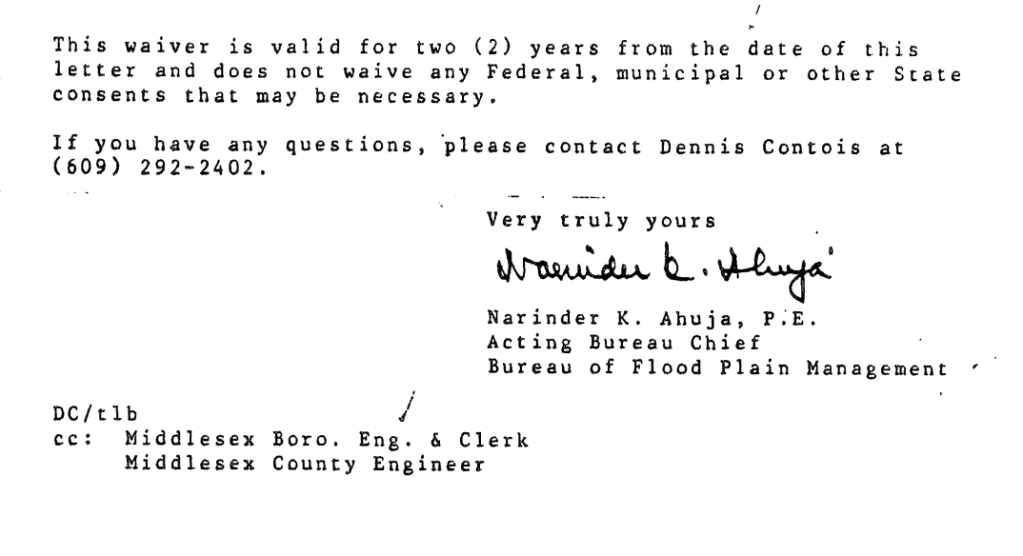
While reviewing the subdivision proposal, the board determined that Hearthstone’s plan did not require a DEP stream encroachment permit. A letter from the DEP made that determination official.
Reminder
Subscribe to Inside – Middlesex. Enter your email address to subscribe to this blog and receive notifications of new posts by email. It is absolutely free.
 Inside - Middlesex
Leave a comment