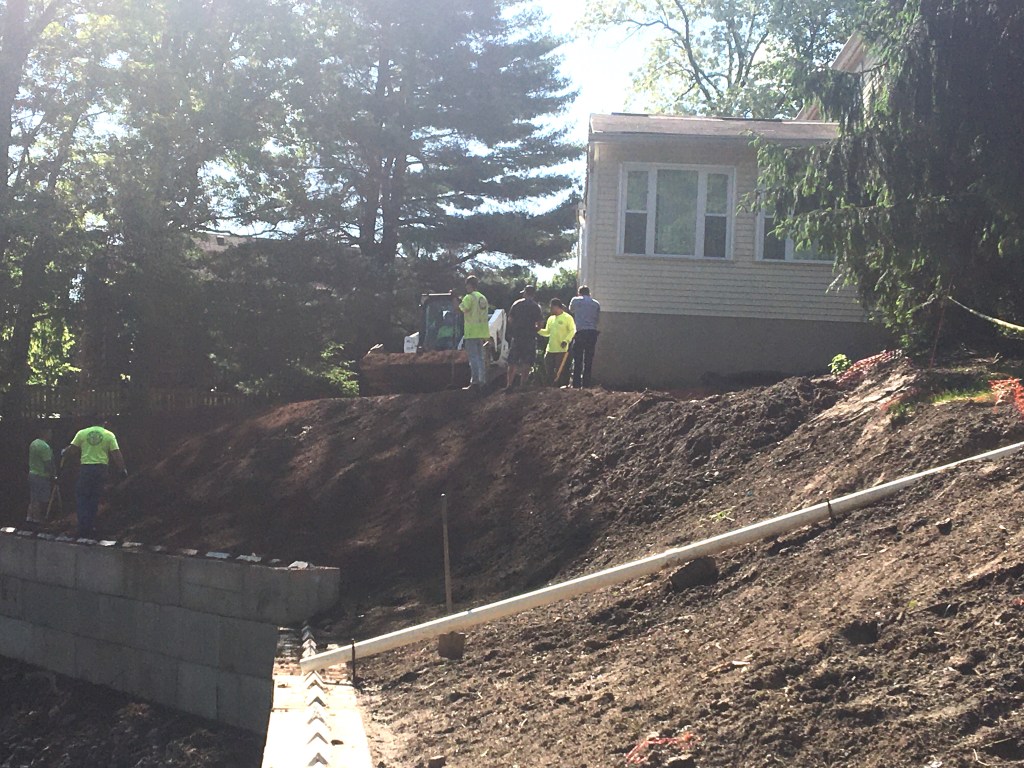
More than 360,000 pounds of concrete now protect two endangered Heather Lane homes from erosion that threatened to slide them into an adjacent stream.
Department of Public Works members, with the help of excavator L.N. Rothberg & Son and a municipal engineer, erected the concrete wall over five days earlier this month. On Monday morning, DPW workers filled in soil above the wall, restoring the yards lost to the erosion.
DPW Superintendent Len Vidal will give a presentation on the project at the Borough Council’s Tuesday, May 28 session. At a meeting last week, officials applauded the work for successfully adding a protective layer to the homes, that have been endangered since September 2021’s Hurricane Ida poured rain on the area.
One of the Heather Lane homes was deemed uninhabitable in March 2022 after erosion reached its foundation. That residence, which formerly generated $14,000 in annual property taxes, could be returning to the tax rolls pending inspections, according to officials.
All told, the wall project has cost about $60,000, according to Vidal. The wall is considered a “semi-permanent fix,” he said. Its placement is such that a more permanent barrier could be constructed between it and the adjacent stream.
The borough began planning for the DPW project last fall after unsuccessful efforts to spur the U.S. Army Corps of Engineers to address the erosion. Its completion has been slowed, first by a supply chain materials issue, then by above-average precipitation early this year.
Affected residents and borough officials have contended that the erosion worsened after Ida due to the Army Corps’ Green Brook Flood Management Project. Residents have claimed a nearby flood wall and pumping station increased the velocity of the water flowing through the stream following large-scale storms.
The Army Corps has disputed that argument, asserting that the erosion would have occurred even if the flood control work had never been initiated.
Earlier this year, the borough was unsuccessful in obtaining a multi-million-dollar Resilient Communities grant from the state. But officials have said they will apply again, hoping the funding would pay for the more permanent barrier. Officials had feared that if unchecked, erosion problems could spread to nearby homes on Holly Court.

Although not considered “permanent,” it’s hard to envision that the DPW-built wall won’t be effective in preventing the wearing away of the two Heather Lane homes’ backyards.
The new, two-section wall is 300 linear feet in length, according to Vidal. It comprises 96 cement blocks, each weighing 3,800 pounds. One section has blocks stacked four rows high, the other three rows tall. Each section has one row beneath the ground.
During construction, a crane lifted the blocks and swung them into position. “It’s pretty much like a huge retaining wall,” Vidal said.
Reminder
Subscribe to Inside – Middlesex. Enter your email address to subscribe to this blog and receive notifications of new posts by email. It is absolutely free.
Visit Inside – Middlesex on our new Facebook page.
 Inside - Middlesex
Leave a comment