
School officials’ claims of a classroom shortage are driving taxpayer calls to re-register all Middlesex Borough students as a residency test. So far, it has not come to pass, as the district continues with its existing policy on student registration.
Re-registration proponents assert it would identify any pupils who should not be attending Middlesex schools. That might lower costs, they contend, and render unnecessary any steps to provide more classroom space.
At a recent Borough Council meeting, an audience member noted the results of a re-registration carried out seven or eight years ago. That effort, the taxpayer said, found there were students being educated in borough schools who were not Middlesex residents.
The Middlesex Borough school district’s budgeted cost per pupil was $18,529 during the 2022-23 academic year, according to figures released by the state Department of Education.
Inside – Middlesex visited the registration section of the Middlesex Borough school district’s website. It lays out proof of residency requirements imposed on a prospective student’s family/guardian when registering a child to attend a district school.
Officials would say those requirements ensure that only legitimate Middlesex Borough residents are taught in its schools. Skeptical taxpayers, however, might claim there are loopholes that non-residents can slip through.
Parents are asked to complete an initial registration step online. First, parents are asked the names of all students they are registering. Next, they are asked to “list all addresses” they would like district mail sent to. “A legal residence must be entered,” the website reads. Parent and emergency contact info is required. Parents are then asked to complete a home language survey.
Proof of residency is the next step. “You will need to prove the student is a resident of Middlesex by meeting with the District Attendance Officer and presenting proof of residency,” the website reads.
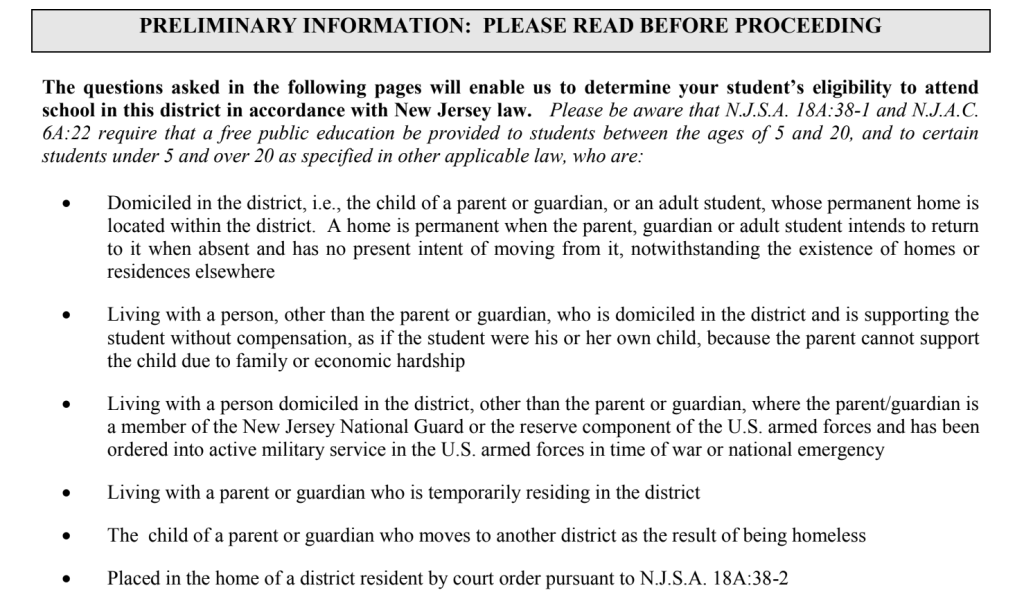
The site directs parents to a listing of preliminary information acceptable in proving residency.
The prelim info outlines state law’s eligibility requirements for attending a school district. Among the initial bulleted items are:
- Domiciled in the district, i.e, the child of a parent or guardian, or an adult student, whose permanent home is located within the district. A home is permanent when the parent, guardian or adult student intends to return to it when absent and has no present intent of moving from it, notwithstanding the existence of homes or residences elsewhere.
- Living with a person, other than the parent or guardian, who is domiciled in the district and is supporting the student without compensation, as if the student were his or her own child, because the parent cannot support the child due to family or economic hardship.
- Living with a parent or guardian who is temporarily residing in the district.
The website states several situations that do not affect a student’s eligibility to enroll in a school. They include:
- Immigration status, except for students holding or seeking a visa specifically to attend school.
- Absence of a certified birth certificate or proof of identity, although it must be provided within 30 days.
- Absence of a student’s prior education record, although it could affect a student’s placement.
Documentation that may demonstrate a pupil’s eligibility for district enrollment includes:
- Property tax bills and other documents showing home ownership.
- Voter registration, licenses, financial account and utility info.
- Government-issued business documents.
“The totality of information and documentation you offer will be considered in evaluating an application, and, unless expressly required by law, the student will not be denied enrollment based on your inability to provide certain form(s) of documentation when other acceptable evidence is presented,” the website reads.
“Please be aware that any initial determination of the student’s eligibility to attend school in this district is subject to more thorough review and subsequent re-evaluation, and that tuition may be assessed in the event that an initially admitted student is later found ineligible,” the website adds.
Parents are urged to print out a residency checklist. That form asks for original birth certificate, passport or other official document to verify student identification.
Parent/guardian information is requested, including identification documents. A property deed/title, home/mortgage contract, and current lease, including landlord name, are requested as proof of residency.
Two additional documents are requested as proof of residency. They include: property tax or utility bill, driver’s license, homeowner’s/renter’s insurance, or voter registration.
“In the event an investigation should disclose that my child(ren) is/are not entitled to a free education in the district, I understand the student(s) will be dis-enrolled and that I will be held responsible and that I will be held responsible for the cost of tuition to the district for any periods of unlawful attendance,” the form reads.
Parents are asked to sign a sworn statement. Landlords are also asked to sign a sworn statement for any adult renter enrolling a district pupil who does not have a formal lease. Parents/guardians are also advised they will need to provide their child’s immunization record, transcript or report card from previous school, and transfer card.
Reminder
Subscribe to Inside – Middlesex. Enter your email address to subscribe to this blog and receive notifications of new posts by email. It is absolutely free.
Visit Inside – Middlesex on our new Facebook page.
 Inside - Middlesex
Leave a comment