When a high school senior runs for a Board of Education seat, it’s a community story. Under most circumstances, it would also seem to be of interest to at least some of the candidate’s classmates.
Prior to the Nov. 5, 2024 general election, a Middlesex High student-journalist certainly thought so.
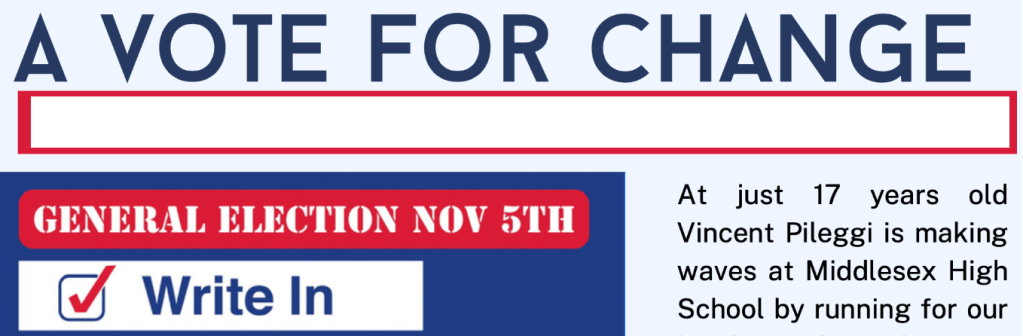
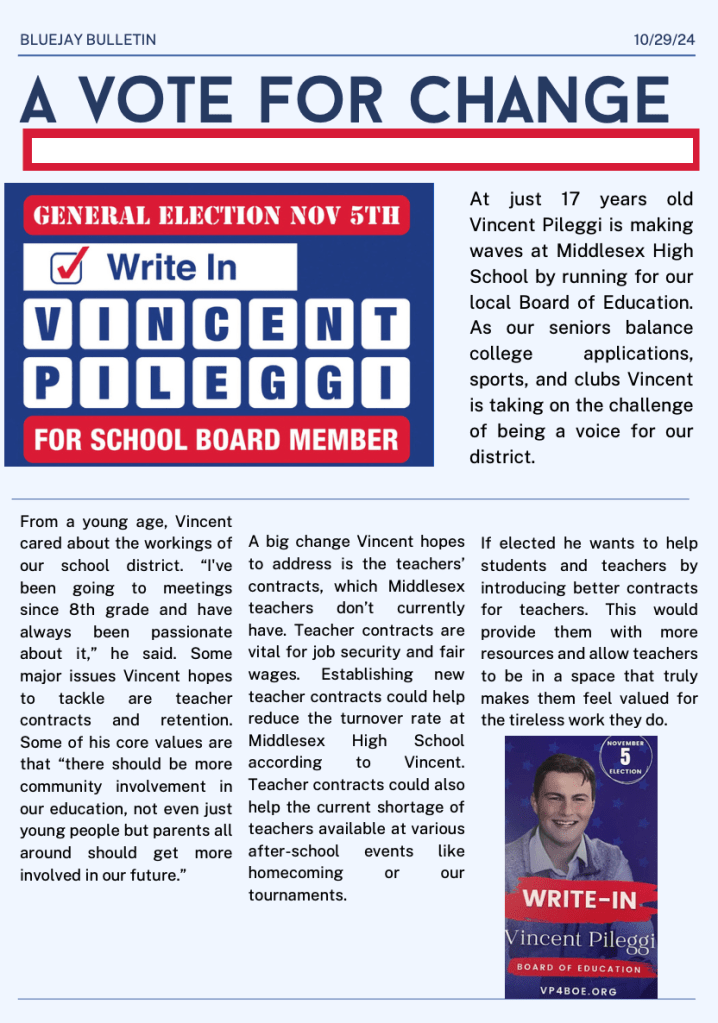
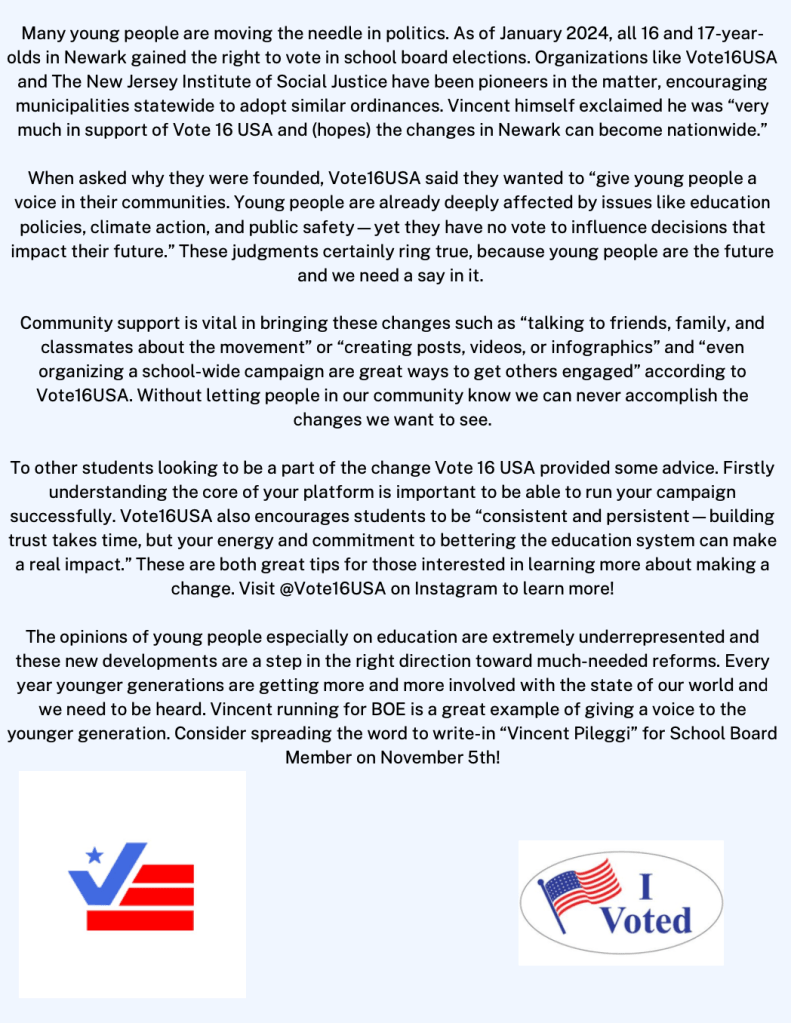
The student-journalist composed an article titled “A Vote for Change” for a school literary publication. Its topic was the write-in board candidacy of the author’s 17-year-old MHS classmate Vincent Pileggi.
School administration, however, viewed the coverage as problematic. After the article was submitted, it was deemed to be contrary to a 2003 Middlesex Board of Education policy. The article was not published.
The board policy states instances when written materials are supposedly not protected bv the right to free speech. Among them: when they “promote, favor, or oppose any candidate for election to the board.”
While the article did not clearly endorse Pileggi’s candidacy, it concludes: “Vincent running for BOE is a great example of giving a voice to the younger generation. Consider spreading the word to vote to write in ‘Vincent Pileggi’ for school board member on Nov. 5.”
What appeared to be a policy infraction, became less cut-and-dried when Pileggi contacted the Student Press Law Center (SPLC). The SPLC is a Virginia-based non-profit that promotes, supports and defends press freedom for high school and college student-journalists.
An SPLC attorney told Pileggi the district’s policy is contrary to New Jersey’s 2021 New Voices legislation signed into law by Gov. Phil Murphy. That law protects the press freedom of New Jersey’s public school student journalists. The law says that student media cannot be censored by school officials, except in certain very narrow circumstances, and that advisers cannot be penalized for refusing to infringe on their students’ press rights.
In the opinion of the SPLC attorney, Pileggi said, he could pursue litigation to permit publication of the article at MHS. From a practical standpoint, however, publishing the article post-election would accomplish nothing in terms of spurring student voter participation.
Instead, Pileggi has opted to push for change, publicly noting that at least one BOE guideline is outdated and questioning whether there are more. He voiced his concerns during the pubic comments portion of the Middlesex Board of Education’s Jan. 7 reorganization meeting.
Through the filing of an Open Public Records Act request, Pileggi uncovered that the school board had its attorney research the matter last fall.

Neither Superintendent Dr. Roberta Freeman, nor board members responded to Pileggi at the reorg session. When emailed by Inside – Middlesex two days later, Freeman replied but did not comment on the article’s content.
“I do wish to respond to the statements Vincent Pileggi made during the public comments portion of the reorganization meeting,” Freeman wrote. “However, I wish to do so directly to Mr. Pileggi. As I have stated at several public meetings, I prefer to address concerns directly with individuals for several reasons:
“It fosters a more personal and meaningful interaction.
“Direct communication reduces the risk of misinterpretation, which can occur in written formats such as blogs or social media.
“It aligns with the works of leadership experts Patrick Lencioni and Stephen Covey,” Freeman added. “Lencioni emphasizes that people need to feel heard and understood before they can fully engage in a solution, while Covey’s principle, “Seek first to understand, then to be understood,” underscores the importance of direct conversations for achieving clarity and productive resolutions.”
Mike Hiestand, senior legal counsel for the Student Press Law Center, said via email on Jan. 9 that Middlesex school officials were wrong to block the article’s publication.
“Absent their ability to point to something in the story that falls into one of the law’s unprotected speech categories (all of which are listed in subsection (c) of the law), school officials had/have no authority to censor the article,” Hiestand wrote. “My understanding is that school officials did not – and could not – do so. Indeed, New Jersey’s New Voices law – currently one of 18 such state laws in the country – was enacted specifically to prevent the sort of censorship that appears to be taking place at Middlesex High School.”
“My understanding is that school officials expressed some concern over it being political speech,” Hiestand added. “Student journalists are not school employees or school agents – they are private citizens – and would not be subject to any New Jersey law that might prevent public employees from engaging in political speech, which, is generally entitled to the highest degree of free speech protection.”
At the reorg, Pileggi told the board that his schoolmate’s article was not an endorsement. Instead, it focused on Pileggi’s platform and decision to run.
The guideline in question – Middlesex BOE Policy 5721 – was last updated “prior to my birth,” Pileggi told the board.
“Policies like 5721, written in 2003, don’t reflect modern laws, technology, or the understanding of current students’ rights,” Pileggi said. “Continuing to rely on outdated policies not only leads to missteps like this but also creates an environment where students and staff may feel silenced or unsupported.”
“Schools should teach students to think critically,” Pileggi added, “engage in dialogue, and speak up – not silence them with outdated or misapplied policies.”
Reminder
Subscribe to Inside – Middlesex. Enter your email address to subscribe to this blog and receive notifications of new posts by email. It is absolutely free.
Visit Inside – Middlesex on our new Facebook page.
 Inside - Middlesex
Leave a comment