
After years of enduring geese droppings in public parks – and with the problem seemingly worsening – Middlesex Borough government will step up efforts to deal with the issue.
Mayor Jack Mikolajczyk and the Borough Council heard several neighbors of Haverstick Park urge them to address the problem at that facility at the governing body’s Tuesday, Feb. 11 meeting. The mayor acknowledged that an abundance of geese feces sometimes plagues Victor Crowell Park as well, and other Middlesex locations.
In the short-term, dog decoys will be placed at Haverstick by the Department of Public Works (DPW) in an attempt to dissuade geese from visiting. Officials are taking more time to sort out a long-term solution.
Farragut Avenue resident Robert Gorr noted that youth soccer players and other children who use Haverstick’s playground are regularly exposed to the droppings. Gorr, a former councilman, called the situation “a very ongoing issue.”
Later in the meeting, Hazelwood Avenue resident Bob Edwards noted the dangers of contact with goose droppings, particularly for children and pets. Edwards, also a former councilman, noted the droppings can cause exposure to E. coli, Salmonella and other health risks.
“They are probably there almost every day,” Gorr said, adding that 50 to 100 of the birds sometimes descend on Haverstick at one time.
“This year, and last year, I don’t know what happened but we’ve had a very large population of geese,” said Gorr. The droppings problem, he said, also affects the nearby street and neighboring residential lawns.
Gorr said geese even came to Haverstick Park during a recent ice storm. “It’s unbelievable,” he said.
They land at 6 a.m. each day, sometimes fly out, but then later converge again on Haverstick, Gorr said
Another neighbor told of a veterinarian bill in the thousands of dollars from her dog’s exposure to geese feces.
Mikolajczyk said the geese problem affects even his own yard in another part of town. “It is an issue,” he said. “I don’t know what can be done. I don’t know the scope of it, but I do recognize it’s an issue.”
At Victor Crowell, DPW will clean a path, the mayor noted, “and in the afternoon, you’re back where you started from.”
DPW Supervisor Len Vidal said his department has attempted to address the geese problem in recent years. The birds are an issue throughout Central Jersey, Vidal said, adding, “It’s not just Middlesex.” Exactly what can be done long-term remains a somewhat open question.
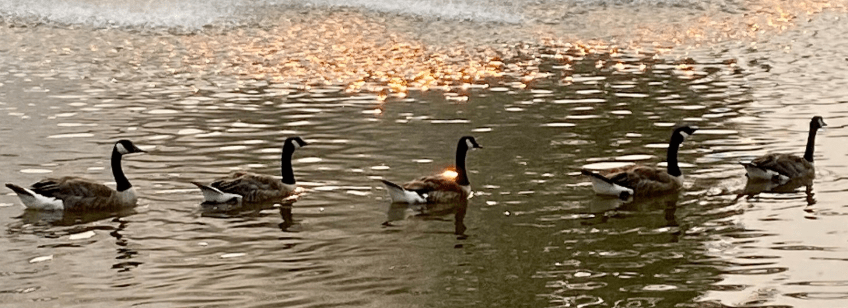
According to Vidal, environmentally friendly repellants are one option. The granules are costly but have been effective when used at Victor Crowell Park. Firms that use dogs to chase geese can be hired, Vidal said, but they pose a liability risk and must be insured under the borough’s coverage.
Haverstick’s playground will likely get fenced off from the rest of the facility, officials said. It’s hoped that move will lessen the geese presence at that part of the park.
“The way to fight this thing, I hate to say it, is with chemicals,” Edwards advised the mayor and council. He suggested the borough contact county or state health officials.
“They’ve been here for 10,000 years,” Edwards said of geese, “and they’re not going away.”
Even if effective chemical treatment is used, Edwards said it could take months to solve Haverstick’s geese problem.
Reminder
Subscribe to Inside – Middlesex. Enter your email address to subscribe to this blog and receive notifications of new posts by email. It is absolutely free.
Visit Inside – Middlesex on our new Facebook page.
 Inside - Middlesex
Leave a comment