The Merriam-Webster dictionary defines “fair” thusly – “marked by impartiality and honesty: free from self-interest, prejudice, or favoritism.”
It’s not easy to apply that wordy description directly to union contract negotiations, although it gets used often. In general, it seems to suggest two opposing sides should be open with each other and cognizant of their respective circumstances.
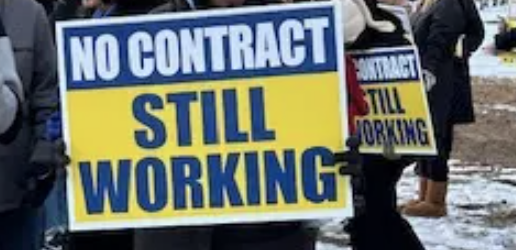
The contract dispute between the Middlesex Board of Education and the Middlesex Education Association goes on. The MEA, which represents the Middlesex Borough K-12 district’s teachers and support staff, had its prior contract expire last June 30. Without a new deal, the union has worked under the terms of the lapsed contract during the 2024-25 academic year.
The state of negotiations had its latest public airing at the board’s Wednesday, Feb. 19 action meeting. Again, it showed the two sides still have a gulf between them.
There were respective assessments of the talks’ status from a school board member and the MEA president. The board’s attorney chimed in, as did about a half-dozen teachers and union supporters. About 30 MEA members attended the meeting.
The next attempt at a resolution is a second mediation session on March 24. The initial meeting with a mediator on Jan. 27 did not yield an agreement.
Board member Todd Nicolay, a member of the district’s negotiating team, said the two sides are “working toward a mutually beneficial resolution.” The respective bargaining teams met eight times between May and September 2024 before involving a mediator, he said.
The first mediation session in January lasted more than four hours, according to Nicolay. Open issues include the board’s right to implement block scheduling at Middlesex High School. The MEA has the right to negotiate that scheduling’s impact, said Nicolay.
High school block scheduling is a system where students attend fewer classes per day, but each class lasts for a longer period of time.
Pay increases offered by the board, Nicolay added, have been “at or above the county average.” He did not give specifics.

“We understand that the ongoing negotiations can be frustrating to those involved,” said Nicolay. “However, the negotiating team from the Middlesex Board of Education is diligently working towards a fair and amicable resolution.”
Nicolay’s assessment was questioned by the MEA and supporters. At one point, MEA President Carolyn Muglia challenged the board’s negotiating team to meet with the union as soon as possible without a mediator.
The stalled talks mean any intended pay increases are delayed. Muglia noted that situation causes a financial detriment for the MEA as salaries remain frozen.
“The cost of living has gone up,” she said. “Our salaries have not.”
Muglia also criticized the need for a mediator to help resolve the contract stalemate, “We’re letting somebody else do the work for us,” she told the board.
In an article published on the New Jersey Education Association website on Jan. 31, Muglia gave additional details of the negotiations. The article includes photos from an MEA rally held on the day of the first mediation session. More than 150 union members and supporters attended the rally on the sidewalk in front of Mountain View Park.
In that article, Muglia said the official responsibilities of her members “have outpaced the salary guide. Sticking points in the negotiations appear to be competitive compensation for extra-curriculars, time provided for educator training, and scheduling concerns.”
“The board, on the superintendent’s recommendation, instituted a schedule that is out of compliance with contract language developed collaboratively by the MEA and past administrations,” Muglia said in the online article. “They have dismissed us and dismissed the benefits of a positive, supportive school culture and climate.”
The same day as the NJEA article’s publication, the New Jersey School Boards Association posted an update on its website regarding ongoing contract bargaining in the Garden State.
New Jersey teacher contract settlements covering the 2024-25 school year are averaging 3.45% pay increases, according to the NJSBA. The organization surveyed 183 districts whose teacher contracts expired last June 30. Of those, 90% responded.
Among the responding districts, 126 have reached a ratified successor agreement. Teacher contracts which start with the 2024-25 school year are reporting an average salary increase of 3.71% for 2024-25 and 3.56% for 2025-26, the NJSBA said.
The median teacher’s salary in the Middlesex Borough school district was $75,228 during the 2023-24 academic year, according to state Department of Education statistics. That was below the statewide median of $80,196 and ranked 17th among 28 public school districts, vocational and charter schools in Middlesex County.
Reminder
Subscribe to Inside – Middlesex. Enter your email address to subscribe to this blog and receive notifications of new posts by email. It is absolutely free.
Visit Inside – Middlesex on our new Facebook page.
 Inside - Middlesex
Leave a comment