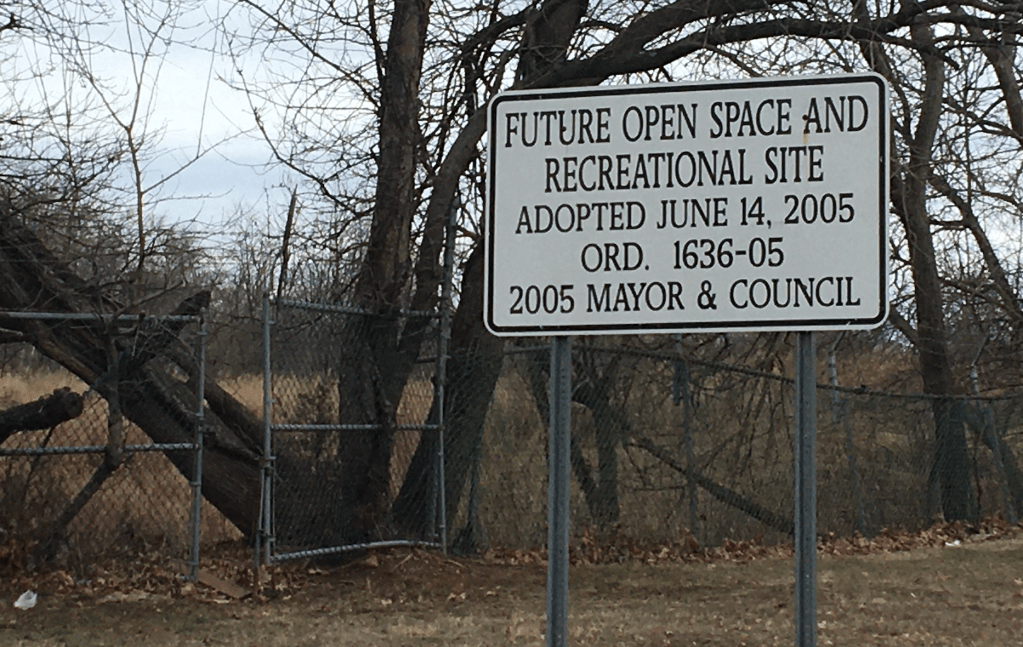
It sits on Mountain Avenue, across from the Middlesex Borough police headquarters, cordoned off by an ineffective metal fence with two gaping holes.
The site, now overgrown with vegetation, served as the former Middlesex Municipal Landfill (MML) from roughly 1940 to 1974. It’s had a tumultuous history, as recounted in a Risk Assessment on the United States Army Corps of Engineers (USACE) website.
In 1960, during a civil defense exercise, elevated radiation levels were recorded in the landfill. It was determined that an estimated 6,000 cubic yard of soil from the Middlesex Sampling Plant (MSP), located further south on Mountain Avenue, had been trucked there and dumped between November 1947 and October 1948. That fill was excavated during grading work at the MSP site.
It wasn’t just any dirt. The MSP property contained the by-products of the Manhattan Project, the federal effort to develop the first atomic bomb. Contaminated soil was accepted at the landfill, because at that time, disposal of municipal and industrial waste was “unregulated,” the Army Corps notes.
In 1961, the United States Atomic Energy Commission removed about 650 cubic yards of contaminated soil from the landfill. Five acres of the site were sold to the Presbyterian Church two years later.
When the nearby church site, municipal complex parking lot and the Department of Public Works recycling center are included, the former landfill comprises 37 acres, according to USACE.
In the ensuing decades, federal and state environmental agencies commenced various efforts to determine just how badly the former landfill was polluted. Approximately 31,000 cubic yards of contaminated soils were removed from
the landfill in the mid-1980s.
On June 14, 2005, the Borough Council attempted to put a positive spin on a bad situation, by adopting an ordinance prohibiting development of the former landfill for residential or commercial uses.
Instead, the acreage was designated as a “future open space and recreational site” by the governing body. Two signs erected outside the former entrance to the landfill still proclaim the not-quite-landmark legislation.
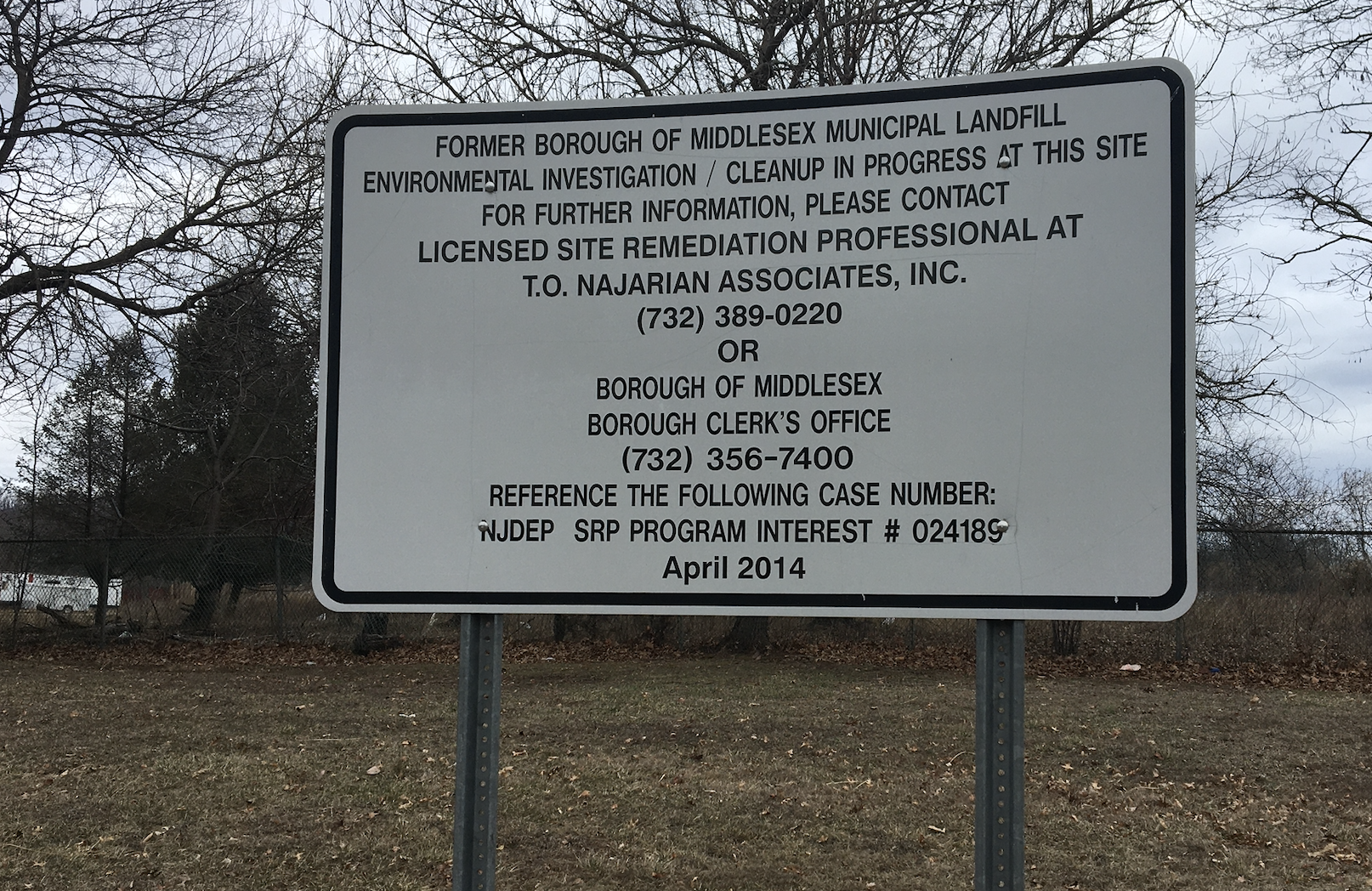
The borough’s administrative code explains the 2005 decision thusly:
“This governing body does hereby determine,” the code reads, “that the former landfill site be protected from being used as a residential or commercial property and that the site be reserved for and used only for both active and passive recreational uses and parking requirements associated therewith.”
Twenty years later there are neither picnickers nor walking trails at the former landfill. Since 2005, those moseying through the site have tended to wear hazmat suits rather than cargo shorts.
History posted on the Army Corps site paints a picture of two decades’ worth of monitoring and sampling. It’s typically done quietly, only drawing attention on a community Facebook page if someone drives by and then posts about the presence of government vehicles.
That historical account is an alphabet soup who’s who of pollution-related monitoring agencies and acronyms.
It can be a dizzying read for the layman. It seems safe to conclude there are still worries about the site’s environmental cleanliness. The landfill status posted by the Army Corps states that a Remedial Investigation, Feasibility Study, and Proposed Plan have been completed. Three years ago, the Corps determined it would remove more contaminated soil, with the work schedule to be completed this year.
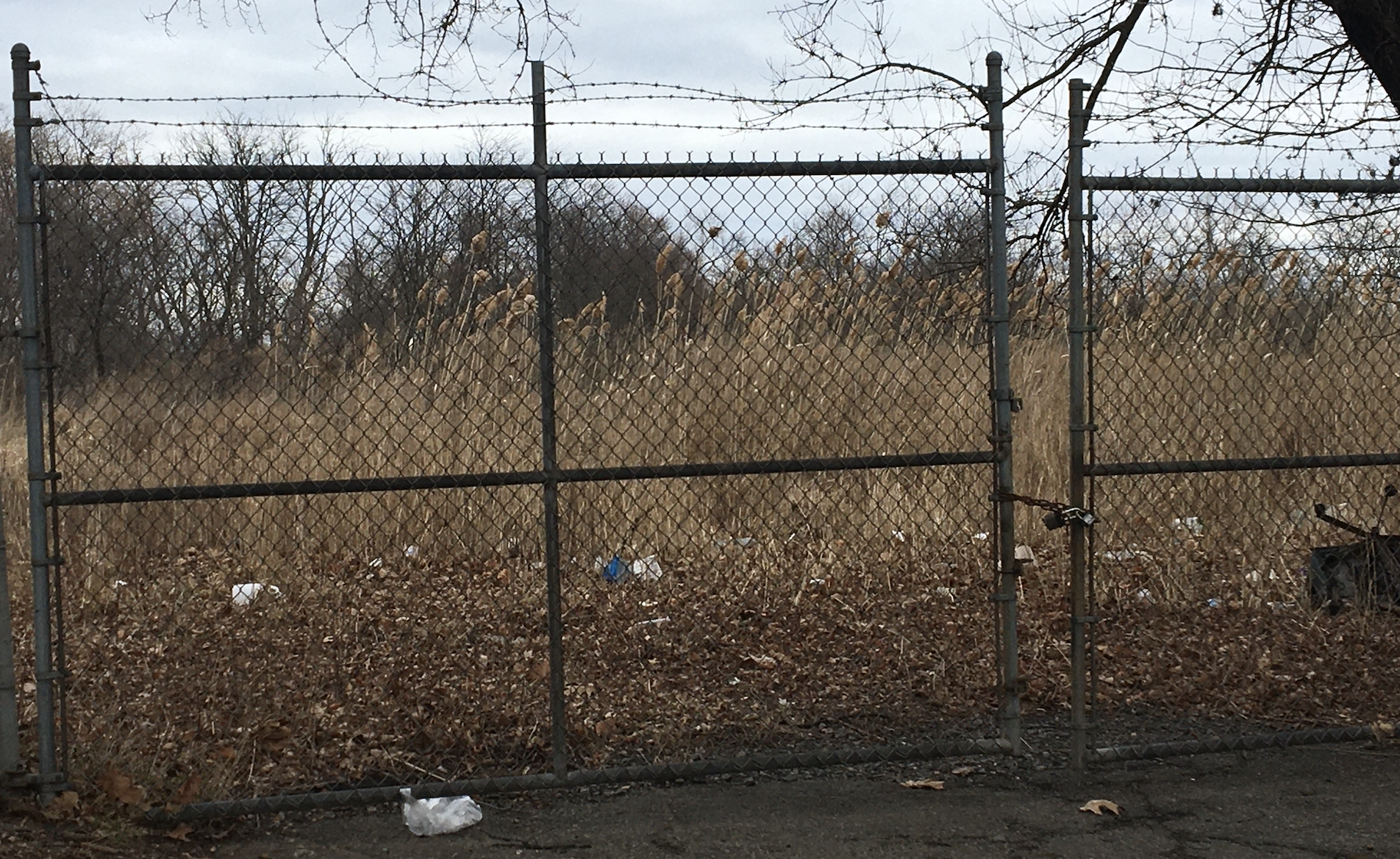
Meanwhile, public access to the landfill is not-so-restricted.
“The area is currently undeveloped and readily accessible to unauthorized foot traffic and vehicles through breaches in the surrounding fence,” the risk report noted in 2016. Nine years later, it continues to be “readily accessible.”
The stuff in the ground, still isn’t so great either. “Elevated levels of methane (exceeding 10 percent of the lower explosive limit) continue to exist on the landfill property and were reported during the 2010 soil boring activities, as well as during the 2014-2015 RI field program,” according to the Army Corps.
Apparently, some area residents still haven’t gotten the memo that the landfill was closed 50 years ago.
“The presence of miscellaneous debris scattered across the landfill indicates that MML continues to be used for disposal of waste (such as household appliances, automobile parts and tires, bottles/cans, and textile goods). There is no record of the amount or type of waste disposed at the landfill,” the risk report states.
During recent years’ council meetings, there’s been no extensive public mention of the former landfill’s use. lt won’t achieve its envisioned recreational purpose any time soon, if ever.
Potential acquisition of the former Presbyterian Church property – technically part of the landfill – was abandoned last year by Mayor Jack Mikolajczyk and the council. The governing body had hoped to use the former church building for additional municipal space, and possibly an emergency shelter.
Why was the purchase nixed? An environmental study’s results spurred the mayor and council to abandon the deal.
Reminder
Subscribe to Inside – Middlesex. Enter your email address to subscribe to this blog and receive notifications of new posts by email. It is absolutely free.
Visit Inside – Middlesex on our new Facebook page.
 Inside - Middlesex
Leave a comment