
When a group of Middlesex school district critics mentioned a petition drive to give Board of Education appointment power to the mayor, objections surfaced on social media:
“You can’t do that. Politics should be kept out of school decisions.”
They should be, but they’re not, particularly in New Jersey in the year 2025. Anyone who’s lived in Middlesex Borough for a few decades – and is honest about the history – knows there’s sometimes been a political tint to the town’s school board.
A voter might hold valid reasons for opposing the Middlesex mayor receiving BOE appointment authority. De-politicization of educational decision-making isn’t one of them. Politics and school decisions are married now in New Jersey, for better or for worse, and there’s no getting around it.
Not every school board member has direct or tangential ties to one political party or the other. But there are ample Middlesex examples of when partisan politics and the Board of Education weren’t distant from each other.
In the 1983, the unpopular decision to close Pierce School on Walnut Street caused controversy. A then-former Democratic councilman was dispensed to the nearby neighborhood to quell the unrest, telling taxpayers, “The town needs the tax revenue (from building homes on the site).”
Our board presidents? Some of them have been no strangers to municipal politics in their other lives. We had one – Democrat Ron Dobies – go on to serve as Middlesex mayor for nearly 30 years. Current Republican Mayor Jack Mikolajczyk is a former board president and not afraid to publicly refer to decisions and events from his tenure.
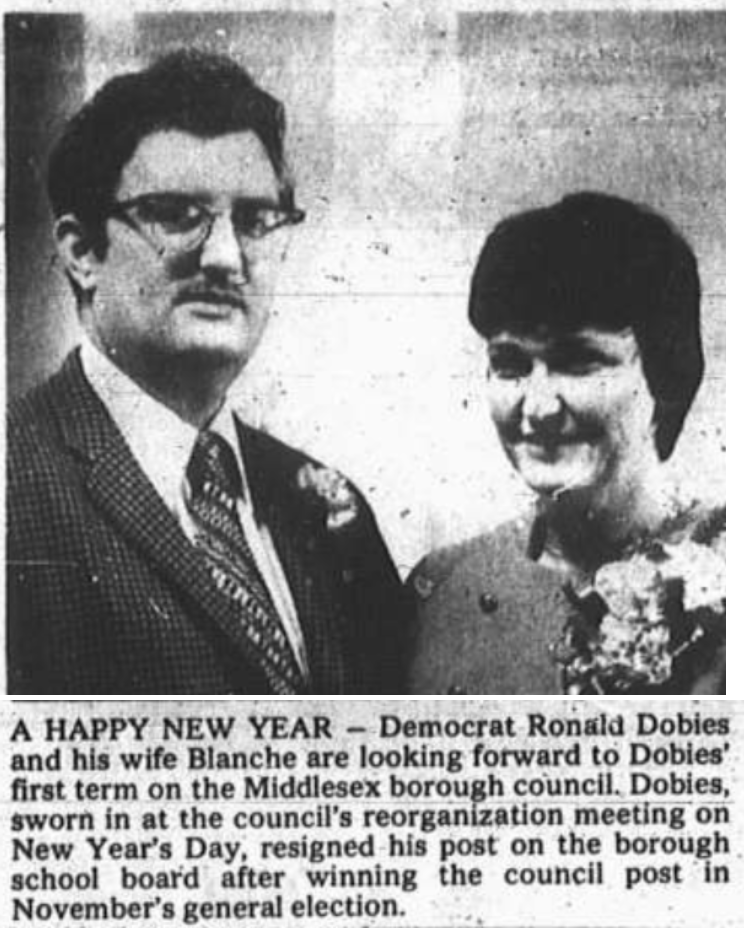
(Photo from the 1/8/1976 Middlesex Chronicle).
It’s not been uncommon to have a few spouses of council members serve on the school board over the years. It’s unlikely the couples banned discussion of educational issues around their dinner tables.
The issue of politics and the school board is getting amped up a bit in the coming election. You have a sitting Republican Councilman, Jeremiah Carnes, running for a board seat, as is former GOP Councilman Martin Quinn. Martin Quinn’s wife, Shannon, is wrapping up her school board term and running instead for council this year.
One sitting board member, Sharon Schueler, has served for nearly 20 years. Her husband served multiple terms as a Democratic councilman not that long ago. School board candidate Natasha Rouse is married to Vincent Rouse, who is a 2025 Democratic candidate for Borough Council.
Meanwhile, two current board members – Todd Nicolay and Thomas Thornton – serve on the Republican Municipal Committee, which endorses council and mayoral candidates.
Still think that all who run the school district are distanced from partisan politics?
If you’re dismayed by this, take heart. It’s more rampant in some other towns. Certainly, other aspects of public education in New Jersey do nothing to discourage the influence of politicos.
In 2012, the state gave local school districts the option of conducting their elections in November to coincide with the general election in which presidents, governors, U.S. senators and state legislators are selected, The move was viewed as a way to increase voter participation in school elections.
Prior to that time, school elections had always been held in April, separate from the partisan campaigning for other elected positions. While board candidates, don’t carry a “D” or “R” next the their names in the voting booth, moving their election to November has spurred some voters to ask who’s aligned with who.
A few years ago, the state Department of Education developed a controversial new health education curriculum. Parents in some districts objected to the new course of study that injected subject matter on gender identification. That further politicized educational decision-making as some parents had no problem with the subject matter. Others viewed it as governmental overreach.
The New Jersey School Boards Association and New Jersey Education Association both employ Trenton lobbyists who are paid to sway state legislators. The NJEA significantly funded the gubernatorial campaign of its former president, Sean Spiller, who ran unsuccessfully in the 2025 Democratic primary.
Everyone, it seems, has a point of view on taxpayer-funded education, its effectiveness or lack of it. It’s unrealistic to think that political parties and their active members won’t be among those weighing in and attempting to influence decisions and public opinion.
Reminder
Subscribe to Inside – Middlesex. Enter your email address to subscribe to this blog and receive notifications of new posts by email. It is absolutely free.
Visit Inside – Middlesex on our Facebook page.

 Inside - Middlesex
Leave a comment