After answering a knock on the door, some homeowners have found that they – or more precisely their homes and yards – continue to be haunted by Middlesex Borough’s atomic bomb legacy.
U.S. Army Corps of Engineers (USACE) reps descended on the borough recently, checking the results of an aerial survey conducted in 2021.
Word of the visits broke on social media two weeks ago. The feds’ property inspections were noted briefly during the Borough Council’s Tuesday, Aug. 19 session.
Borough Administrator Michael LaPlace mentioned the inspections during his usual update on goings-on since the prior meeting. When asked, Mayor Jack Mikolajczyk said he’d known of the prior aerial mapping, but did not know followup work was occurring.
The unannounced visits by USACE reps no doubt rattled the homeowners who received them and continue a pattern of often-hushed-up discussion about the Middlesex Sampling Plant’s consequences.
The MSP was established in 1943 as part of the Manhattan Project, used to sample, test, and store uranium, thorium, and beryllium ores for the early atomic energy program, including the development of atomic weapons. Its Mountain Avenue location appears to have been chosen because of the proximity to rail lines. Materials used in atomic research were typically transported between sites in the United States via the railroad, a USACE rep confirmed to Inside – Middlesex in 2023.
MSP operations ceased in 1967, but the site was designated for federal cleanup in 1980 due to radioactive contamination. After decades of remediation by the U.S. Department of Energy and the U.S. Army Corps of Engineers, the site was transferred to the Borough of Middlesex in 2023.
The MSP site’s surrounding area, however, has never seemed to get a completely clean bill of health. That point was driven home by the feds recent visits and other past events.
Due to feared groundwater contamination, well-drilling restrictions were enacted for 250 properties within the MSP’s vicinity in June 2022. Roughly a half-dozen years ago, crews in hazmat suits traversed the former municipal landfill, also on Mountain Avenue, descending into large holes that appeared to be part of an ongoing monitoring operation there.
The former landfill was found to have radioactive contamination in the 1960s, apparently caused by fill trucked there decades earlier from the MSP. Contaminated soil was discovered in 1978 at the Our Lady of Mount Virgin Church rectory and later remediated. Three years later, an extensive soil removal occurred at the MSP site and nearby properties.
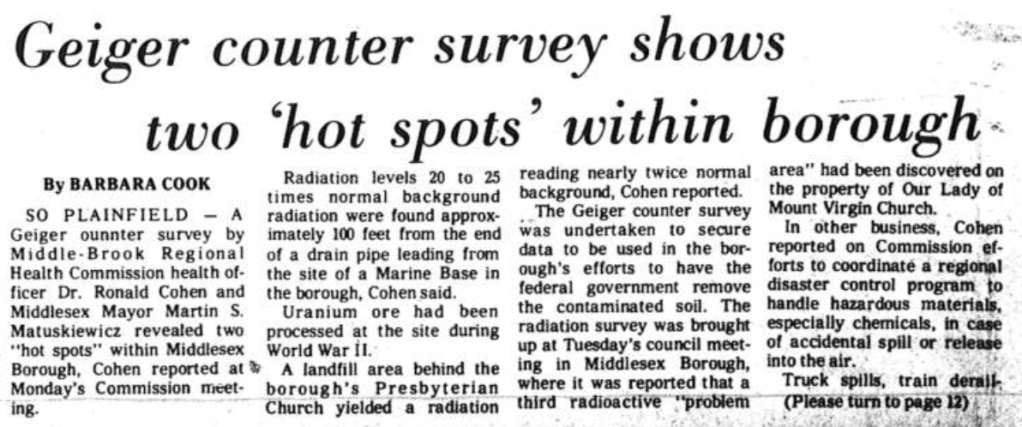
The 2021 flyover and recent site visits have the feds determining if there may be more contaminated spots in the borough. Was even more soil used as fill in the community, further spreading radioactivity? Did wind and/or rain contribute to the spread?
A bulletin published by USACE last April attempts to allay fears. It states that there is “no immediate threat to people’s health or the environment.”
USACE ground crews are attempting to confirm aerial survey results. “It is important to note that USACE investigating a property does not mean there is contamination,” the bulletin reads.
Elevated readings also do not necessarily indicate contamination, it continues, because there are many environmental sources of radiologic activity that can spike those numbers. They include granite stone and building materials like brick.

Despite the assurances, some wonder if there are consequences for potential sellers and buyers of affected properties. If a homeowner just got a fed visit, but is planning to sell their home, do they need to disclose the situation to potential buyers? That question might keep attorneys busy.
Aside from the property owners, the visits have apparently not caused a large ripple of concern throughout the community, as evidenced by only the brief mention at the recent council meeting.
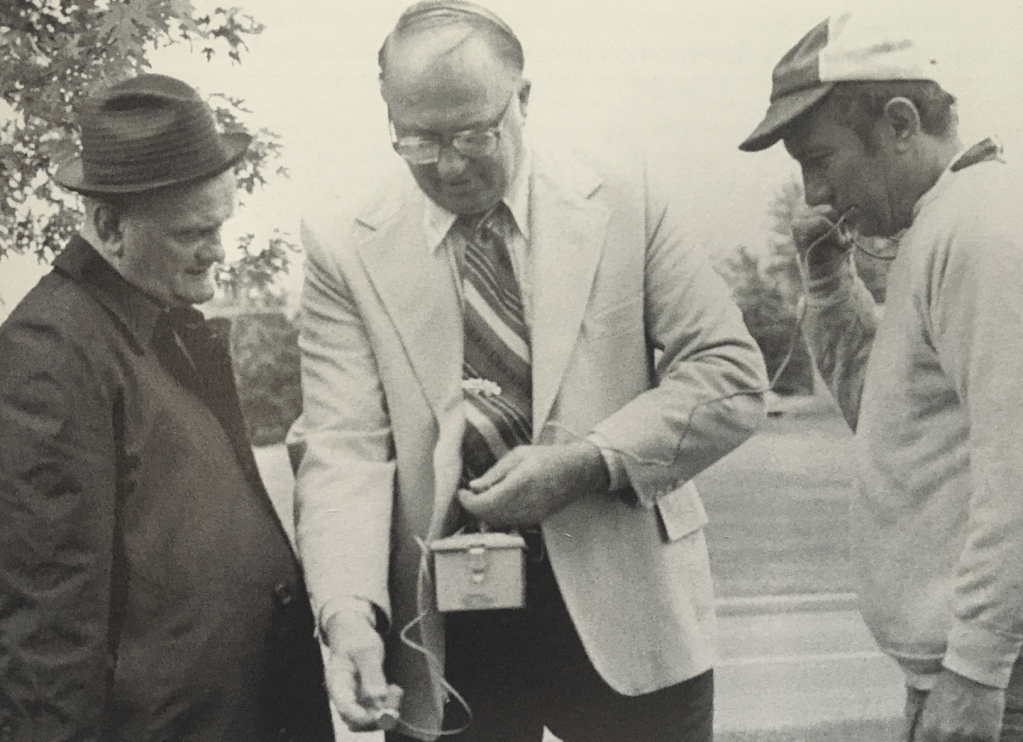
That might suggest Middlesex Borough is becoming desensitized to the presence of uranium contamination. Roughly 45 years ago, the OLMV pastor and sitting mayor used a geiger counter as a prop for a newspaper photo (lead photo). Maybe it was a neat attention-grabber on the newsstand. But did all who saw it grasp the potential seriousness of the matter? After all, Uranium-235 has a half life of roughly 700 million years.
What’s the atomic half-life of periodic angst? Hiroshima and Nagasaki were destroyed in a horrific way by American-made atomic weapons. But the Japanese people, in a sense, have moved on. Perhaps there’s a different curse placed on the society that unleashed that hell – ongoing environmental headaches.
Reminder
Subscribe to Inside – Middlesex. Enter your email address to subscribe to this blog and receive notifications of new posts by email. It is absolutely free.
Visit Inside – Middlesex on our Facebook page.
 Inside - Middlesex
Leave a comment