
Taxpayers are apparently on the hook for a nearly $41,000 unpaid school lunch tab left by students in the Middlesex Borough district.
The tab, run up by pupils during the past two academic years, will be paid off by the Board of Education. The board contracts with Maschio’s Food Services to handle school lunches.
Cancellation of the existing lunch program debt – totaling $40,596 – was approved by the board at its Wednesday, July 17 meeting.
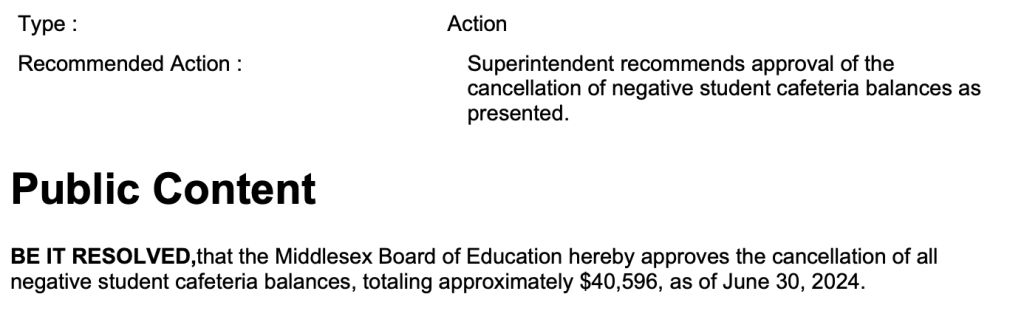
“The district has exhausted all possible avenues within its purview to recoup these funds, however, measures taken have not yielded the desired results,” School Superintendent Dr. Roberta Freeman wrote on July 25 in response to a citizen inquiry.
“The balances written off will actually be charged to the 2023-24 budget,” Freeman added. “There are funds available.”
Freeman wrote that “the canceled debt comprises outstanding balances from student accounts over the past two years.”
Inside – Middlesex emailed Freeman on Monday, July 29 seeking additional information about the unpaid lunch balance. As of Wednesday evening, Aug. 7, the superintendent had not responded.
The email asked how many students had unpaid lunch balances, which schools they attended, and what steps the district attempted to secure payment from the students or their family/caregiver.
Local taxpayers would likely favor further efforts by Middlesex school officials to collect the unpaid lunch funds. But to do so, would seem to put the district at odds with state law.
In September 2023, the Deptford Township superintendent announced changes to that district’s policy on outstanding food service charges. It stated that students whose parents or guardians owed $50 or more in meal fees would be provided a “basic lunch” or no food at all.
Gov. Phil Murphy’s office responded quickly, saying the policy was contrary to student protections outlined in state law, according to a Sept. 23, 2023 online article published by NJ Spotlight News. The Deptford district discontinued the policy.
“The governor and his administration will not stand for policies that ostracize and harm New Jersey students, especially those who may already come from a family struggling to put food on the table,” Deputy Press Secretary Christi Peace said at the time.
The Hunger-Free Students’ Bill of Rights Act was passed by the State Legislature and signed into law by Murphy in 2020. It halts the stigmatization of students whose caretakers are behind in school meal payments.
The Act states that a school district cannot publicly identify or stigmatize a student who cannot pay for breakfast or lunch by serving them an alternative meal. The Working Class Families Act was passed and signed into law two years later, expanding access to school meals.
Rutgers University estimates that roughly 40% of Middlesex Borough households deal with some level of food insecurity, according to data the college tracks in an online portal.
The Rutgers-administered site – njfooddashboard.rutgers.edu – estimates that more than 7% of Middlesex Borough households live in poverty and about 33% are categorized as “ALICE households.”
ALICE stands for Asset Limited, Income Constrained, Employed. It is a measure of households that are earning above the federal poverty level, but still struggle financially, because they cannot afford basic household necessities.
(Note: Vincent Pileggi contributed to this report.)
Reminder
Subscribe to Inside – Middlesex. Enter your email address to subscribe to this blog and receive notifications of new posts by email. It is absolutely free.
Visit Inside – Middlesex on our new Facebook page.


Leave a Reply